The latest issue of Amici del Meyer magazine features an interview with Mario Carrara, Vice President of Cartiere Carrara S.p.A., in which he discusses the close relationship between our company and the Meyer Foundation.
This partnership was born out of a desire to support those who, every day, work for the wellbeing of hospitalised children, their families, and medical research.
The Meyer Foundation carries out projects that not only improve healthcare but also make the hospital a more welcoming and human place.
Standing by its side means sharing values of responsibility, solidarity, and care for the future of the next generations.
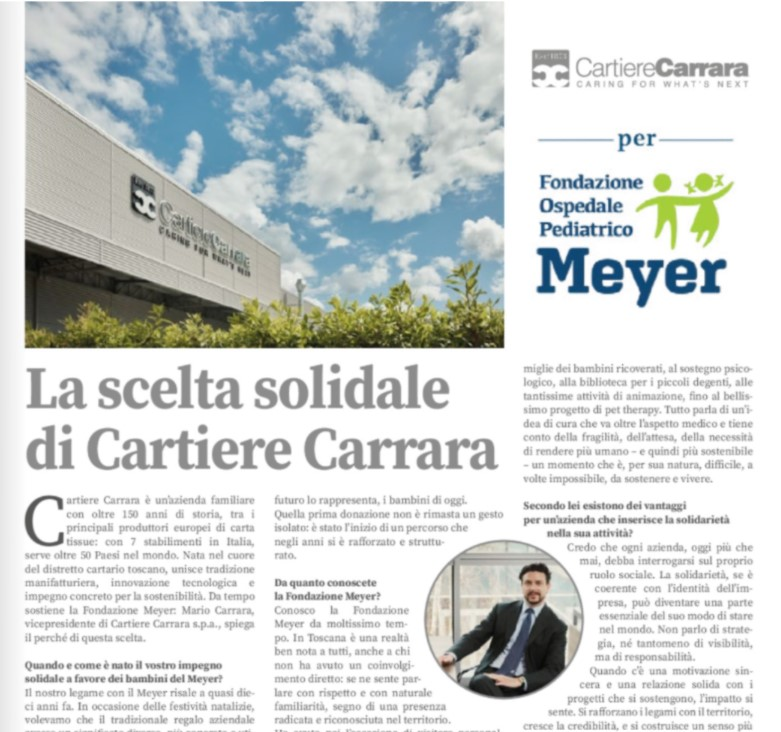
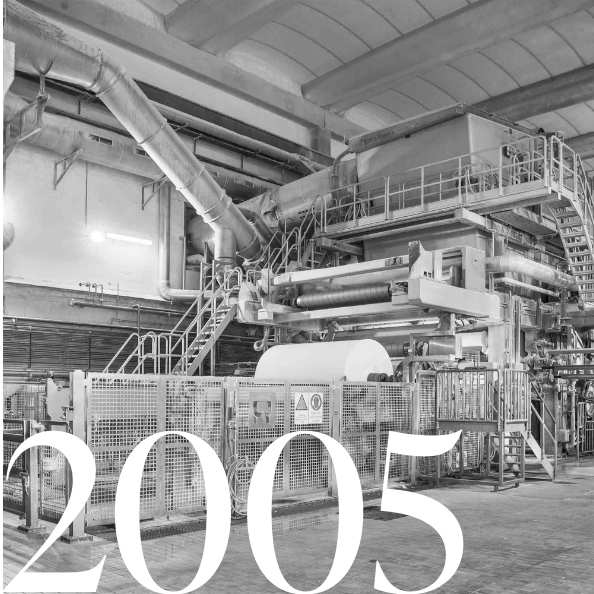
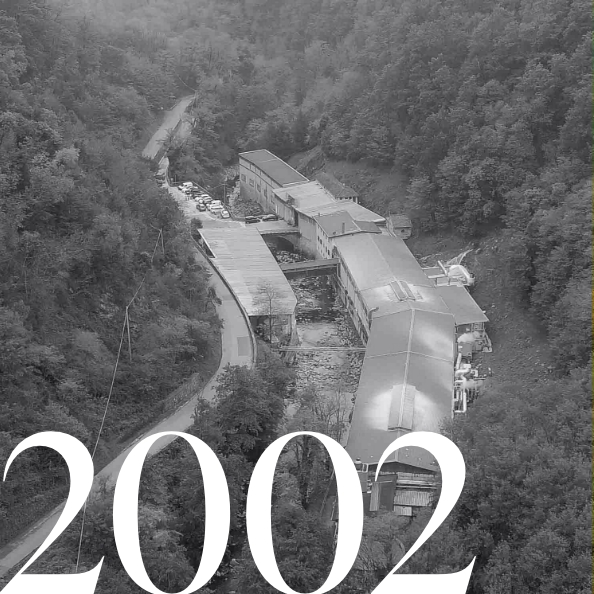
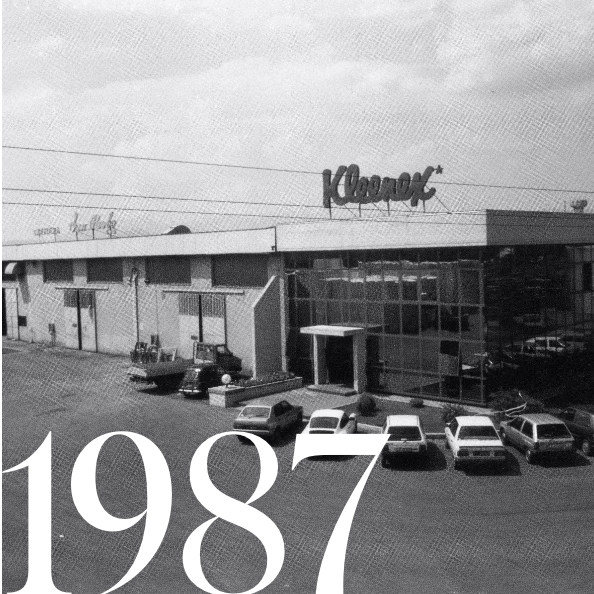
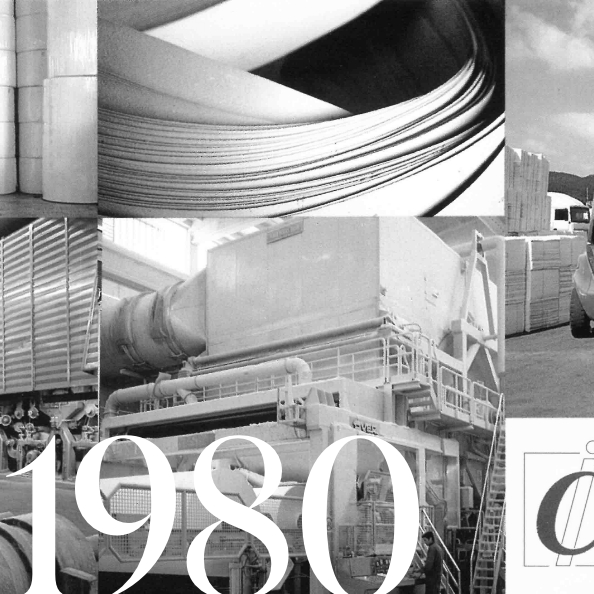
Cartiere Carrara is a family-owned company with over 150 years of history and is among Europe’s leading producers of tissue paper. Founded in the heart of Tuscany’s paper district, it combines manufacturing tradition, technological innovation and a genuine commitment to sustainability.
With seven plants across Italy, it serves more than 50 countries worldwide through three business areas: the Professional Division (Away From Home), offering disposable solutions made from virgin or recycled fibre for the Ho.Re.Ca, Community, Office & Industrial markets under the brands BulkySoft and Carind; the Consumer Division, producing personal and household hygiene products such as toilet paper, kitchen rolls, napkins, tissues and facial tissues under the brands Tuscany – The Beauty of Paper, BulkySoft and Maxi; and the Parent Reels Division, supplying semi-finished products for B2B and B2C converting markets.
Quality, care for people and a long-term vision guide every choice the company makes.
When and how did your commitment to supporting the children of the Meyer Foundation begin?
Our relationship with Meyer dates back almost ten years. During the Christmas holidays, we wanted our traditional corporate gift to have a different, more tangible and meaningful value. We thought that supporting Meyer would be the right way to do something beyond the ordinary — to make a concrete contribution to an organisation we had long known and admired.
We chose an organisation that is real, reputable and deeply rooted in the local area, and Meyer immediately seemed the most natural point of reference.
As a company with a long family and industrial history tied to this region, we feel both a duty and a desire to play an active role in our community. It is not simply a matter of “giving something back”, but of recognising ourselves as part of a wider context that must be supported and helped to grow responsibly.
In Meyer we found an institution that truly embodies the values of care, expertise and attention to people. After all, our company’s payoff – “Caring for what’s next” – has always seemed perfectly aligned with the daily mission of the Meyer Foundation.
If, in our work, we care for people and look to the future responsibly, the Foundation, together with the hospital, takes care of those who are that future – today’s children.
That first donation was not an isolated gesture; it marked the beginning of a journey that has, over the years, grown stronger and more structured.
How long have you known the Meyer Foundation?
I have known the Meyer Foundation for a very long time. In Tuscany, it is a well-known institution — even for those who have never been directly involved with it. People speak of it with respect and natural familiarity, which is proof of how deeply rooted and recognised it is in the local community.
I later had the opportunity to visit the hospital in person and to learn more about the many initiatives promoted by the Foundation. On that occasion, I was able to see even more clearly the tremendous work carried out every day with dedication, professionalism and a profound sense of responsibility.
What has impressed you most about the Florence paediatric hospital and its Foundation?
The suffering of children is perhaps the most inexplicable and, in some way, the most unjust thing one can witness. It affects you directly — it is something that is hard to rationalise. For this reason, entering Meyer means coming into contact with a place that strives to respond to that pain through care, research and attention to every detail.
What struck me most is the tangible commitment to investing not only in clinical excellence, but also in education and innovation, as demonstrated by the Meyer Health Campus. Alongside this are the many activities designed for children and their families: family accommodation for parents of hospitalised children, psychological support, the in-hospital library, numerous recreational activities, and the wonderful pet therapy project.
Everything there reflects an idea of care that goes beyond the purely medical — one that takes into account fragility, waiting, and the need to make a difficult, sometimes almost unbearable experience more human, and therefore more sustainable.
In your view, are there benefits for a company that integrates solidarity into its business activity?
I believe that today, more than ever, every company should reflect on its social role. Solidarity, when it is coherent with the company’s identity, can become an essential part of the way it operates in the world.
I’m not talking about strategy or visibility, but about responsibility.
When there is genuine motivation and a solid relationship with the projects you support, the impact is tangible. Connections with the local area are strengthened, credibility grows, and the company gains a deeper sense of purpose. There is no need to overstate it — coherence, when it exists, speaks for itself.
What advice would you give to a company considering embarking on a similar path of solidarity?
Giving advice in this field is never simple, as every organisation has its own history, identity and priorities. Rather than giving advice, I would encourage companies to look around them, to listen carefully to what is happening in their communities, and to ask themselves sincere questions about how they can be of help.
It’s important not to look for shortcuts or ready-made solutions. Solidarity cannot be improvised — it must be built over time, by choosing a project that aligns with the company’s way of being, and that can be understood, shared and genuinely felt by the people within it.
And once you decide to begin, do it with seriousness and continuity. Impact comes when there is consistency — when an initiative is not isolated, but part of a credible and ongoing journey. That takes time, respect, and an awareness that this is a relationship, not a one-off action.